Mediterranean, Atlantic, Baltic, North Sea
A genuine exchange of experiences across European coastal territories — diverse histories, economies and governance traditions facing shared structural vulnerability.
European Network
European Network
Coastal Europe is entering a period of profound environmental, social and economic transition. This network brings together researchers, experts and territorial actors to understand, compare and support the futures of coastal communities and tourism economies under increasing climate pressure.
Upcoming — ISA World Congress of Sociology 2027
A dedicated session organised by the network at the ISA World Congress of Sociology 2027 — a first milestone in building the European research agenda on coastal transitions.
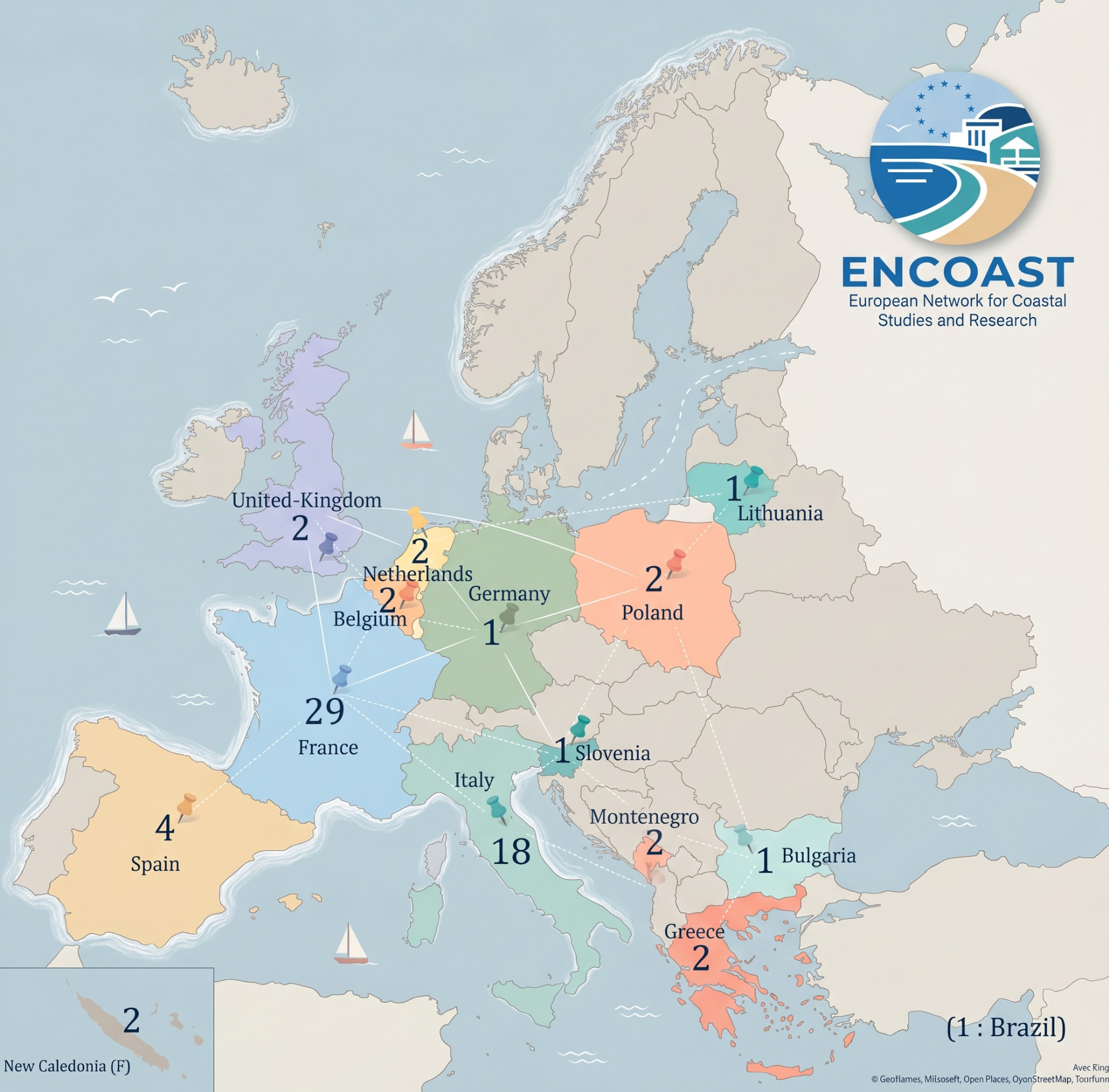
A growing European network
The map presents the countries currently represented across the network, including overseas territories, and the number of participating researchers in each one.
The scientific context
Drawn from the European Environment Agency, Copernicus Marine Service and recent peer-reviewed scholarship, these data points outline the urgency of coordinated European research on coastal transitions.
Why coastal studies nowEEA, 2024
van den Hurk et al., 2024
van de Wal et al., 2024
EEA, 2024
Borriello et al., 2025
Cortés Arbués et al., 2023

Why coastal studies matter today
More than 200,000 kilometres of European shoreline, home to approximately 200 million people, face simultaneous pressures from rising seas, intensifying storms, accelerating erosion, marine pollution and the structural fragility of tourism economies developed without ecological limits.
For coastal populations whose economic identity is anchored in tourism, these are not abstract changes. They translate into shorter beach seasons, degraded water quality, damaged infrastructure and the progressive transformation of the landscape that defines the value and identity of their place.
Yet research at the intersection of climate, coastal dynamics and tourism remains fragmented across Europe. This network exists to address that deficit.
The network's mission
The European Network for Coastal Studies and Research is a collaborative scientific platform bringing together scholars, researchers and specialists engaged in the study of coastal tourism, territorial change, environmental vulnerability and community adaptation across European coastal regions.
It addresses a clearly identified scientific gap: the absence of a structured European research platform dedicated to the present state and future trajectories of coastal tourism under accelerating climatic, ecological, economic and social pressures.
The network is currently being established through a first cycle of meetings among scholars, researchers and experts from different European countries.
A genuine exchange of experiences across European coastal territories — diverse histories, economies and governance traditions facing shared structural vulnerability.
Sociology, geography, history and the humanities working alongside environmental and economic sciences to capture the lived experience of coastal transformation.
An independent pool of multidisciplinary experts producing comparative territorial assessments and actionable recommendations for institutions at all levels.
An open European invitation